Rewards API#
Introduction#
In eprllib, Rewards are used to guide the learning process of Reinforcement Learning (RL) agents. They
provide a numerical signal that indicates how well an agent is performing in the environment. The Rewards API
provides a structured way to define and configure these reward functions. This document provides a detailed
explanation of the Rewards API in eprllib.
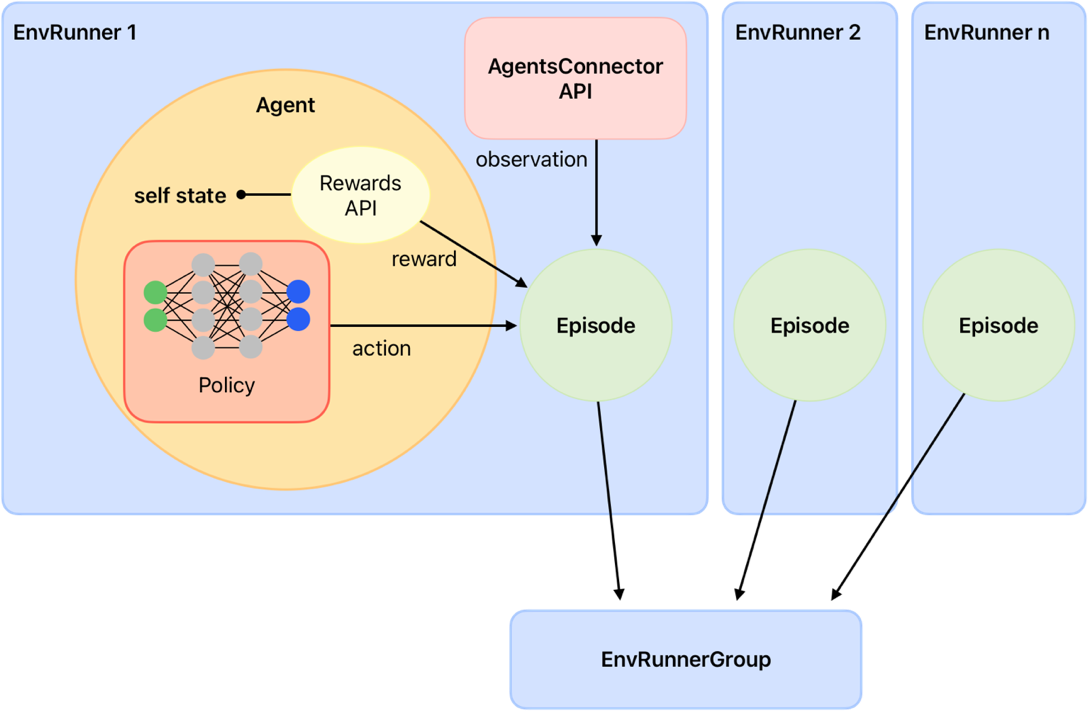
Reward functions are responsible for calculating the reward that the agent receives at each time step. They take into account the current state of the environment, the agent’s observations, and the agent’s actions to determine the reward.
Common Reward Function Examples:
Energy Consumption: A reward function that penalizes high energy consumption.
Thermal Comfort: A reward function that rewards the agent for maintaining comfortable temperatures.
Combined Energy and Comfort: A reward function that balances energy consumption and thermal comfort.
Custom Metrics: Reward functions can be created to optimize any metric available in the EnergyPlus simulation.
Creating Custom Reward Functions:
You can create custom reward functions to implement more complex reward logic. A reward function should:
Take the agent’s name, the thermal zone, and any other relevant parameters as input.
Take the kwargs to receive the info dictionary.
Return a numerical value representing the reward.
Relationship with Observations, Actions, and Environment State#
Reward functions use information from the environment, the agent’s observations, and the agent’s actions to calculate the reward. The flow of information is as follows:
Environment State: The reward function has access to the current state of the EnergyPlus environment.
Agent’s Observations: The reward function can use the agent’s observations (as defined in
ObservationSpec).Agent’s Actions: The reward function can take into account the actions that the agent has taken.
Reward Calculation: The reward function combines this information to calculate a numerical reward value.
Custom Reward functions#
Here’s a complete example of how to define and use a reward function: